Sportvision

Research has shown that sporting performance is directly linked to vision.

Whether you are an amateur or professional sportsman, our qualified Sportvision specialist, Alan Macdonald, can examine your eyes and use this information to enhance your vision and maximise your sporting performance.

A full Sportvision examination involves many tests and therapies which you will not find in a normal eye examination, including:

  • peripheral awareness
  • eye speed
  • vision in normal and low light levels
  • eye dominance
  • muscle balance and accuracy
  • individual colour preference
  • plus many other binocular vision tests.

A full visual screening takes about 30 mins and includes general information on vision required for your sport and eye exercises to improve your vision. You will also receive recommendations on appropriate sunglasses, contact lenses or sports spectacles.

Teams like Manchester Utd, England’s Rugby world cup winning squad, F1 drivers, Wimbledon Champions and Professional Golfers such as Tiger Woods and Ernie Els have all used Sportvision Specialists to enhance their own sporting performance.

To see how you can benefit, contact your local Hughes, Macdonald and Davidson Opticians, who will arrange for Alan Macdonald to contact you.

Golf

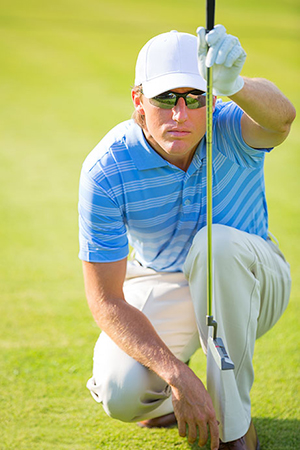
Golfers need good eye to hand co-ordination. Most athletes know they are either right-handed or left-handed and they adjust body movements accordingly. But they may not realize that their dominant eye may process visual information more fully and accurately than their non-dominant eye. In golf the proper address position is eyes directly over the ball with the dominant eye over the back tip of the ball. Golfers also need good focus flexibility which gives them the ability to change focus from a faraway object to a near one, or vice versa. Depth perception allows you to make spatial judgments, including how far away the pin or hole is from you. In golf, depending on the type of muscle balance you have, you may consistently putt long and hit the ball low and as the club goes under the ball you get a high trajectory. Other muscle balances tend to putt short and hit the ball high, causing a low trajectory. Therefore, knowing this will assist your game.

Accurate Golf

  • Hand-eye coordination
  • Dominant eye
  • Focus Flexibility
  • Depth perception
  • Muscle balance

Cycling

Both mountain and road cyclists need good contrast sensitivity which allows them to perceive bumps and objects in the road (same background). Dynamic visual acuity helps cyclists see clearly when moving quickly. Improved depth perception helps cyclists negotiate turns and obstacles, while making spatial judgements, including how far and near objects or people are. Peripheral awareness gives cyclists the ability to perceive what’s going on at either side of them without moving their head. Eye speed and accuracy of eye movement allows you to cycle faster. For outdoor use, the eyes also have to be protected from the UV sunlight and from injury in the event of a fall.

  • Hand-eye co-ordination.
  • Bike Position
  • Contrast sensitivity
  • Dynamic visual acuity
  • Depth Perception – distance to bend/obstacle
  • Peripheral awareness
  • Eye muscle control – speed, position & movement
  • Fatigue over length of cycle
  • Glare sensitivity
  • Different tracks have different lighting
  • Bumpy tracks require stable vision system

Rugby

Rugby players require depth perception for throwing accurate and straight balls into the line-out. Inaccurate eye muscles will result in over or under throwing. Good depth perception is also required to track the ball and time the jump for the catch. It enables spatial judgements for optimum catching and assessing the opponent’s body position and angle. Peripheral awareness of other players will allow you to exploit overlaps and choose the best angle of attack. Peripheral awareness and high visual acuity enables players to work the scrum and spot the ball, while excellent depth perception is required for the long pass. Visual memory enables player has the ability to keep their eye on the ball and be aware of the position of other players, giving them the edge. Hand-eye-foot coordination is required for accuracy when kicking the ball. Kicking a penalty, conversion or drop goal requires visualisation and distinctly clear vision to see the angle to the posts. Visual tracking allows players to anticipate the balls trajectory, (good vision and quick reacting focus) and enhances the chance of a steal on the opponents throw.

For the edge in the game of rugby:

  • Depth Perception
  • Hand-eye-foot coordination
  • Peripheral Awareness
  • Visual Acuity
  • Visualisation
  • Visual Memory
  • Visual Tracking
  • Colour Vision

Football

Footballers need good eye-foot co-ordination to shoot with more accuracy and judge the location of the goal. They also need good depth perception to move around the field better, with a clear perception of distance which means accuracy when passing and shooting. Dynamic visual acuity enables you to see clearly when objects are moving quickly and allows you to block shots, intercept passes, angles of attack. Peripheral awareness allows them to read the field more intelligently, aware of player movement and your relation to it. Visual memory enables players to anticipate where the game is going next based on what they see and visual tracking is an important skill required to track and locate the movements of players and direction of the ball on field. Colour vision is also important to detect different colours and shapes.

  • Eye-foot coordination
  • Visual Memory
  • Peripheral Awareness
  • Dynamic Visual Acuity
  • Depth Perception
  • Colour Vision

Skiing

Both mountain and cross country skiers need good contrast sensitivity which allows them to detect changes in the terrain and snow condition (same colour background). Dynamic visual acuity helps skiers see clearly when moving quickly. Improved depth perception helps skiers see shadows and negotiate turns and obstacles, while making spatial judgements, including how far and near objects or people are. Peripheral awareness gives skiers the ability to perceive what’s going on at either side of them without moving their head. Eye speed and accuracy of eye movement allows you to ski faster. For outdoor use, the eyes also have to be protected from the UV sunlight and from injury in the event of a fall.

  • Hand-eye – body co-ordination
  • Contrast sensitivity
  • Dynamic visual acuity
  • Depth Perception – distance to bend/obstacle
  • Peripheral awareness
  • Eye muscle control – speed, position & movement
  • Fatigue over length of ski – reaction time
  • Glare sensitivity
  • Bumpy tracks require stable vision system

Eye Exercises

Here are some easy multipurpose exercises you can perform at home to improve your visual skills.
Practice two or three of these exercises, for 20 minutes, three times a week. Please be aware you may feel some eye strain, but no pain.

  1. To speed up your focus flexibility, practice changing focus between your computer screen and a picture hanging on the wall across the room, or a scene outside the window. Do this for 5 mins, rest and repeat using a different target.
  2. Ever try to put the cap on a pen and miss? Practicing this at arm’s length is one way to improve your depth perception. Another is to hold a cocktail stick at arm’s length and place it into a drinking straw.
  3. To improve peripheral awareness, while on the move, as a passenger in a car or while walking briskly, hold your head steady and try to read road signs, license plates, etc., on your far right or left, without moving your head or eyes. Do for five minutes, rest five minutes and repeat.

Why not think about starting an exercise program to improve your visual performance skills and strengthen your eye muscles.

You’ll SEE the difference whatever your sport.

SPECIAL
OFFERS
Kids Sport Specs, Complete Price £115 Your kid loves football, you love your kids, so check out our special offer on Kids Prescription Sport Specs. Complete price – £115 (lenses and frames). Whatever their sport, be it football, tennis, basketball or track and field, you’ll protect their eyes and help them see clearly while playing...
Read More
BOOK AN
APPOINTMENT

At one of our branches

LATEST
NEWS
Founded in 1997, in Copenhagen, ØRGREEN OPTICS has always followed its own path — an independent brand defined by its use of colour, Danish design heritage and a quiet, uncompromising approach to innovation. Rooted in the rhythm of Copenhagen life, ØRGREEN creates eyewear that feels both timeless and distinctly now. Precision-crafted in Japan, each frame...
Read More