Blog

What to look for in Ski Goggles

Whether you are an avid skier or enjoy only an occasional ski holiday, you’ll need a good pair of ski goggles to protect your eyes and face from wind, sun, ice and snow.

Features to look for in ski goggles

You’ll typically get more features and superior quality with pricier ski goggles. If you are an avid skier, you may want to splurge on top-of-the-line goggles. But you don’t have to buy the most expensive ski goggles to adequately protect your eyes from wind and snow.

Most goggles are designed with many of the same features. Here’s what to consider when shopping for the right ski goggles for you:

Comfort and fit – ski goggles should fit snugly over the area around the eyes to stop snow, ice and wind from obstructing your vision. Make sure the strap for the goggles adjusts easily for a proper fit with or without your helmet.

Foam inserts to keep out wind, ice and debris need to be thick enough to pad your face in case you fall but not so thick that your goggles fog. Proper ventilation also helps prevent fogging.

Field of vision – ski goggle lenses should provide a wide field of vision and excellent peripheral vision for skiing safety.

UV Protection – make sure your goggles have 100% protection from ultraviolet (UV) radiation. Exposure to UVA and UVB rays reflecting off snow can cause snow blindness (photo keratitis), a painful condition that feels like sunburn on your eyes. Long-term exposure can lead to permanent eye damage such as cataracts and other eye conditions.
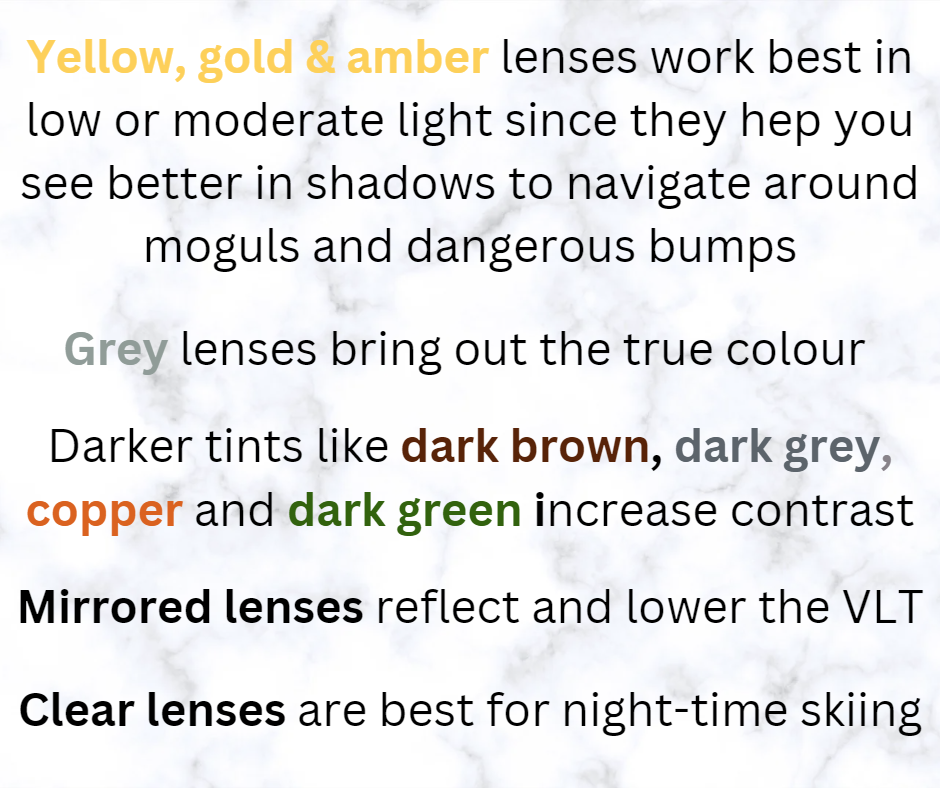
Lenses – Some goggles have only one pair of lenses. Others come with interchangeable lenses for different light conditions. When choosing ski goggles, lens tint and visible light transmission (VLT) are important. A VLT of 15% lessons eye fatigue on bright, sunny days. A higher VLT such as 70% provides better depth perception and colour in low-light conditions.

Prescription Lenses – we stock a wide range of Adidas and Oakley sport goggles, most of which are available with optional prescription lenses. We offer cutting edge technology in our prescription lenses, including Transition and Polarized materials.

Speak to us for a personal recommendation based on your prescription, sport or activity.

Understanding our Vision

The eyes are your body’s most highly developed sensory organs. In fact, a far larger part of the brain is dedicated to vision than to hearing, taste, touch or smell combined!

We tend to take eyesight for granted, yet when vision problems develop, most of us will do what we can to restore our vision back to normal.

Vision loss and changes to your vision can have a drastic effect on your daily life. These can occur due to injury, disease or aging and can be difficult to deal with.

Depending on how the vision loss/changes happened, various aids, surgeries and procedures are available.

Refraction Errors

The most common vision impairments are errors of refraction – the way light rays are focused inside the eye so images can be transmitted to the brain. These can be identified during an eye examination and usually corrected with glasses or contact lenses.

  • Short-sightedness (Myopia)
  • Long-sightedness (Hyperopia)
  • Astigmatism

Eye Disease

Other vision problems can be related to eye disease and disorders of the functional eye and its processing units.

  • Retinal Detachment
  • Macular Degeneration
  • Cataracts
  • Glaucoma

These problems can lead to blurry or defective vision. Treatment of these conditions, depends on the eye disease and may include restoring vision, halting vision loss, and preserving remaining sight.

Attending regular eye exams will help us determine and treat any vision problems identified, so book your next eye exam today.

What are Christmas tree cataracts?

Cataracts are incredibly common, but there are rare types. A colourful, fleck-like Christmas tree cataract can develop as a person ages and can be tied to myotonic dystrophy.

Myotonic dystrophy is a form of muscular dystrophy that impacts the muscles of the body. It can also affect certain organs.

The condition gets its name from the medical term ‘myotonia’ or the inability to relax the muscles. Like its parent condition muscular dystrophy, DM is a degenerative disease that only worsens overtime. The muscles will weaken and shrink as the disorder progresses.

What causes Christmas tree cataracts?

Christmas tree cataracts get their name from their appearance. When they form, they look like multicoloured opacities that ‘glisten’. Unlike other forms of cataracts , the rest of the eye ‘s lens is clear apart from the multicoloured opacities.

The specific colours of the cataract depends on the angle of the light source. Some of the colours you may notice in a Christmas tree cataract include:

  • Green
  • Red
  • Yellow/Gold
  • Orange
  • Brown
  • Blue

The multicoloured flecks that make up a Christmas tree cataract also tends to have a distinct shape. The shape looks like the needles that grow on different kinds of Christmas trees.

What are the symptoms?

You’re not likely to notice any signs of cataract in its early stages. Cataracts can often progress for years before you pick up any symptoms.

The first symptom you might experience when you have a cataract is blurred or cloudy vision, especially at night or driving at night.

Another early sign is can be seeing dull, washed out colours or colours having a yellow hue.

It’s common to have sensitivity to light as a cataract progresses

Can Christmas tree cataracts be removed?

Yes, Christmas tree cataracts can be removed like any other cataract.

When should I see my optician?

It’s recommended that you visit your optician every 2 years, unless otherwise advised or if you notice changes to your vision, which can include:

  • Blurred vision
  • Distorted vision
  • Double vision
  • Cosmetic eye abnormalities (such as unusual flecks or spots)
  • Reduction in visual acuity
  • Eye pain or discomfort
  • Excess eye watering or dryness
  • Light sensitivity

If you are experiencing any of these symptoms, make an appointment today.

Save the Children Christmas Jumper Day 2022

We’re taking part in the Save the Children’s Christmas Jumper Day and this year, its going to be twice as good, no actually, it’s going to be three times as good as ever before!!

That’s because the government has promised to match every £2 donation given this Christmas. And HMD Opticians is also, going to match the £2 donation.  All practices are taking part in the fun this year, see below:

  • Peterhead – 12th December 2022
  • Inverurie – 8th December 2022
  • Turriff – 9th December 2022
  • Banchory – 8th December 2022

So, just click on the link to donate and support our efforts for Save the Children! By pulling on our Christmas jumpers and donating, we’ll be helping mums and babies stay healthy, and giving them a chance for the future they deserve. Just £20 could buy antibiotics to help 10 children beat malnutrition.

You can use the link above or we have our own team text code: HMDSAVE2

To donate text HMDSAVE2 (£2), HMDSAVE2 (£5), HMDSAVE2 (£10) to 70050

Contact us for more information and let’s get giving this Christmas!

Thank you, HMD Opticians

Treat your loved ones to a HMD Gift Voucher this Christmas.

Whether its the latest eyewear trends, this year’s sunglasses or the latest contact lenses, we have something for everyone!

Plus we are offering 10% off all Gift Vouchers for a limited period.

#hmdopticians #christmas2022 #christmasgift


1 … 8 9 10 11 12 … 46
SPECIAL
OFFERS
Kids Sport Specs, Complete Price £115 Your kid loves football, you love your kids, so check out our special offer on Kids Prescription Sport Specs. Complete price – £115 (lenses and frames). Whatever their sport, be it football, tennis, basketball or track and field, you’ll protect their eyes and help them see clearly while playing...
Read More
BOOK AN
APPOINTMENT

At one of our branches

LATEST
NEWS
John Hughes Retirement John Hughes, one of the original founders of HMD Opticians, will retire from the practice on Friday 30th October 2026. The announcement marks the conclusion of his 41 years of service to his patients across the Northeast of Scotland. Mr Hughes started the practice with Alan Macdonald & Donnie Davidson in 1988 to...
Read More