Blog

How time flies…. it’s been 35 years since we opened our doors in Peterhead. We had no appointments booked, wondering how the day would go. We’re glad to say we were busy all day and haven’t looked back.

Local Team Delivering Tailored Service

We’re part of a great community who has made us one of them. Our mission is to provide world class eyecare to our local community. We’ve been lucky to find two locally born, highly qualified and experienced optometrists, Teri and Stuart, who have become a constant strength in our team.

We like to get to know all our patients. How you spend your day, whether that’s in front of a computer or running around after the little ones. We also want to know how you spend your free time. Playing golf, at the gym or enjoying the outdoors.  As we get to know you, it allows us to provide a personal tailored service to meet the needs of each patient.

Investment in Team and Technology
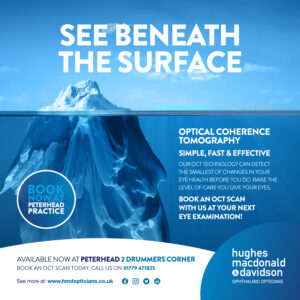
To deliver this standard of eyecare, we are continually investing in our people and our technology. The introduction of Optical Coherence Tomography across our practices, has given our team the tools to better identify, diagnose and treat eye disease. It’s like a CAT scan for your eyes. It gives our experienced team a detailed image of your eye that can see beneath the surface and allows for early treatment, sometimes before the patient even notices, which is always better for the patient. Speak to us about booking an OCT Scan at your next eye examination.

Here’s to many more….

We are adjusting internal processes to become a greener practice and reduce our impact on our world and the environment. We offer on-site recycling for old and unused spectacles and contact lenses. We are introducing environmentally friendly frame ranges and are working with contact lens organisations who are producing plastic neutral contact lenses and changing their processes to protect our planet and preserve our resources You can find out more of what we are doing on our website at Going Greener.

Happy 35th Birthday to us!

Living with Low Vision

What is low vision?

Low vision is defined as a visual impairment that is not correctable through surgery, medicine, eye glasses or contact lenses. Living with low vision, makes everyday tasks such as reading, shopping, recognizing faces, and even crossing the street difficult.

Low Vision is usually caused by eye diseases or other health conditions. Some of these include age-related macular degeneration (AMD), cataract, diabetes, and glaucoma. Eye injuries and birth defects are some other causes. Whatever the cause, lost vision cannot be restored. It can, however, be managed with proper treatment and vision rehabilitation.

What are the symptom’s of low vision?

Some signs to look for that may indicate visual impairment are:

  • Slowness in responding or moving
  • confusion in environments with low contrast or low lighting
  • confusion with faces and identifying people
  • difficulty locating objects that are small or low contrast
  • difficulty paying attention
  • avoiding activities requiring good vision
  • making mistakes in tasks that have small details (i.e. taking the wrong medicine)
  • fear of falling

Everyone experiences vision loss differently, even those who share the same conditions. Most chronic diseases begin with no symptoms; then progress through various stages of blurriness, distortion, dim areas and finally blind spots in either or both eyes.

What can I do if I have low vision?

Attending regular eye exams will allow your opticians to identify any areas of concern. Although, if you experience any changes to your vision, you should contact your optician immediately.

Your optician will explain your diagnoses and provide further information on adaptive devices and aids that will help you in your day to day life, such as:

  • Magnifying screens – they come in different sizes, some as small as a credit card. They may help with shopping and reading labels and small print. There are larger ones that are more suitable for reading books or newspapers.
  • Pocket viewer – looks like a very large-screen mobile phone and makes everything seven times larger.
  • Computer screen magnifiers or screen reader software – will convert the text and images on a computer screen into speech or Braille.
  • Big Button telephones
  • Better lighting in the home

These are just an example of things that may help, your optician will be able to help tailor the aids to your specific needs.

Speak to us if you have any concerns about your vision.


What is AMD?

Age-Related Macular Degeneration (AMD) is a leading cause of vision loss in people 50 years or older. AMD affects the central vision, where the sharpest vision occurs, causing difficulty conducting daily tasks such as driving or reading.

The most common form of AMD is ‘dry’ AMD, caused by the appearance of small yellow deposits called drusen, which form under the retina. Dry AMD usually progresses slowly.

‘Wet’ AMD generally causes more rapid and more serious vision loss. In this form of the disease, tiny new blood vessels grow under and into the retina. These blood vessels are fragile and often break and leak, causing a loss of vision.

What increases the risk of AMD?

  • Family history of AMD
  • Aging – those over 60 years old
  • Race – Caucasians have a higher risk of AMD
  • Sex – females have a higher rate of AMD may be because they live longer
  • Light coloured eyes
  • Smoking
  • Heart Disease
  • High Blood Pressure
  • High Cholesterol
  • Obesity
  • High Sun Exposure
  • Poor diet – with low intake of antioxidants

What are the symptoms of AMD?

There may be no symptoms until the disease progresses or affects both eyes. Vision changes due to AMD are:

  • Difficulty seeing in the centre of your vision, which is needed for reading, sewing, cooking, looking at faces, and driving
  • Trouble seeing in dim light
  • Straight lines start to appear wavy, blurry or missing
  • Fading and/or changes in the appearance of colours

If you experience any of these symptoms, please call for an appointment and speak to us.


Dry Eye Treatment Options

If you have dry eye, your peepers might need a little more TLC when it gets cold.

Cold air doesn’t hold as much moisture as warm air. The drop in humidity makes your tears evaporate even faster. And frigid wind blasting across your face doesn’t help. Plus, you probably spend more time indoors with dry, heated air when temperatures are low.

Winter weather can leave you with eye pain, blurry vision, and/or a gritty feeling. Your eyes might tear up when it feels like something is stuck in them. But these watery drops don’t stick around long enough to provide long-lasting moisture.

The good news is there are ways to protect and soothe your eyes this winter.

  • Use artificial tears
    • Over the counter
    • Preservative Free
  • Make lifestyle changes
    • Blink more – follow the 20-20-20 rule
    • Use Daily Contact lenses or glasses to give your eyes a break
    • Wear sunglasses to protect from the wind
    • Turn heat away from your face (care vents, heaters)
    • Check your medication, some ingredients may make dry eye worse
    • Add more omega-3 to your diet. Healthy fish oils found in fatty fish like Salmon and Tuna (or omega-3 supplements), lower inflammation in your eyes or eyelids.
    • Drink more water
  • Try Home Remedies
    • Use a humidifier – this will add moisture to indoor air
    • Apply a warm compress – cover your eyes with constant low heat for about 5 to 10 minutes. This might help boost blood supply to your Meibomian glands. These are tiny glands along the edges of your eyelids. They make the oily part of your tears, which are a key part of your eye’s moisture.
    • Massage and clean your eyelids – this is another way to help the oil in your glands flow better.

Dry eyes in the winter are not uncommon. Wind, low humidity, cold temperatures, and use of indoor heating systems can all dry the eyes. Fortunately, most symptoms will resolve, however, if your sore eyes persist, talk to us.

Driving Standards in the UK

What Standards of vision is needed for driving in the UK?

You must be able to do the following:

If you are a car drivers (Group 1), you must be able to read (with glasses or contact lenses if necessary) a car number plate made after 1 September 2001 from 20 metres to pass their driving test.

If you are a Lorry or Bus driver (Group 2), you must meet more stringent eyesight requirements. This includes a medical and vision check when you first apply for your bus or lorry licence. It is repeated every five years from the age 45 and every year from age 60.

You must be able to do the following, which your optometrist will complete on your application form:

Read the 6/12 line of letters on a Snellen chart (with glasses or contact lenses, if necessary) using both eyes together or, if you have sight in one eye only, in that eye. Your optometrist will advise you if:

  • You meet this standard
  • You must wear glasses or contact lenses to meet this standard
  • You were not able to meet the standard (even with glasses or contact lenses). You should tell the DVLA.

You must have an adequate field of vision. The DVLA can arrange a test for this at an accredited centre if you sight test suggests that there may be a problem with your peripheral vision.

  • There is no declared history of an eye injury or medical condition which may affect your binocular field of vision (central or peripheral)
  • There is a declared history of an eye injury or medical condition which may affect your binocular field of vision (central or peripheral). You should tell the DVLA who will arrange a field of vision test.

Medical Conditions

You must tell the DVLA about certain eye or general medical conditions. You will find a full list of conditions here .

The most common conditions (but not the only ones) affecting vision are age-related macular degeneration, cataracts, glaucoma and diabetic retinopathy. 

If you are a car driver (group 1), you must tell the DVLA if you have a medical condition affecting both eyes, including different conditions in each eye by reporting it online or by filling in form V1.

If you are a lorry or bus driver (group 2), you must tell the DVLA if you have a medical condition affecting either eye by filling in form V1V

To ensure you vision is fit to drive, book an appointment today for a FREE NHS eye exam, where we will test you eye sight with a Snellen chart. This will ensure that if you have any issues, they are found and you have appropriate prescription to see clearly.

See more at Driving and Your Vision leaflet.


1 … 7 8 9 10 11 … 46
SPECIAL
OFFERS
Kids Sport Specs, Complete Price £115 Your kid loves football, you love your kids, so check out our special offer on Kids Prescription Sport Specs. Complete price – £115 (lenses and frames). Whatever their sport, be it football, tennis, basketball or track and field, you’ll protect their eyes and help them see clearly while playing...
Read More
BOOK AN
APPOINTMENT

At one of our branches

LATEST
NEWS
John Hughes Retirement John Hughes, one of the original founders of HMD Opticians, will retire from the practice on Friday 30th October 2026. The announcement marks the conclusion of his 41 years of service to his patients across the Northeast of Scotland. Mr Hughes started the practice with Alan Macdonald & Donnie Davidson in 1988 to...
Read More